Weird Medicine Healthcare for the Rest of Us

January 28, 2016

Don’t Fear the PPI (but Don’t Take it if You Don’t Need It)

Filed under: Steve's Blog — dr steve @ 10:39 am

Much has been touted in the media and social media about the recent proton pump inhibitor (PPI) study in JAMA relating long term use of these drugs to chronic kidney disease.  There is so much hype that I thought it important to take a closer look.

The study in JAMA is only available to the public as an abstract, which means the authors condensed an 8 page document into 7 paragraphs (basically a half-page).  This is standard…you  have to PAY to be able to read the whole article, and the abstract doesn’t tell the whole story.   Your old pal, an individual who cares about his listeners, arranged to get a full-text copy of the article so we can go over the “numbahs” together.

First, this is a “cohort study” and it’s “retrospective” and therefore “observational.”  This means they took a ton of people who were in another study (Atherosclerosis Risk in Communities (ARiC)) and teased out information they weren’t originally looking for out of the data after the fact.   Basically you take 10,000 or more people and find the ones on long term PPIs and see how many developed kidney disease (and how you define that matters) and compare them against all the people in the group who DIDN’T take PPIs and see if there’s a difference.   This is a decent study, as far as cohort studies go, but when we look at levels of evidence, we see that this kind of study isn’t the best for proving a scientific point:

quality of evidence

There are two levels of evidence above cohort study that are generally considered to result in better quality, and therefore more believable, results.  Performing a double blind, placebo controlled study comparing kidney disease rates in PPI vs Non-PPI users would take another 10 or more years to complete, so this is the best data we have right now (and it’s decent, as I said.)  So let’s go with it.

There were 10482 participants in the ARiC study.   Since this study was not designed to look at PPI use initially (the data was gathered as part of a general information gathering system regarding the patients enrolled), there were some lopsided aspects to the PPI group.  For example, the PPI users were more often obese, white, and hypertensive than the non-PPI users.  This is the kind of thing that can cause bias to creep into a study (hypertensive patients are more likely to develop kidney disease, for example) that would be eliminated from a randomized, control trial.

Of the 10482 participants, there were 1438 cases of chronic kidney disease identified (13.7%).  There were 56 events in the PPI group (of which there were 322 users), amounting to 17.4% (0.174).   In the non-PPI group, 1382 out of 10160 patients developed kidney disease, or 13.6% (0.136).   You can spread this out into patient-years and all kinds of things, but we can see that there is a higher percentage of kidney disease in the PPI group than the non-PPI group, and the difference is 17.4/13.6 or a 27.9% increase.  (They used another cohort to confirm these results and make the data more powerful.)

This is where the headlines come from: “A 30 PERCENT INCREASE IN KIDNEY DISEASE IN PPI USERS!”

So that certainly seems to be “true,” in the sense that to the best of our knowledge, there is an increased risk of chronic kidney disease in people who take PPIs for years and years, but what does that mean for the individual?  And does this make PPIs “bad drugs?”

To figure this out, we need to review the difference between absolute risk and relative risk.

If you have 1000 people in a treatment group and 1000 people in a placebo group, and 10 people have an adverse reaction in the treatment group and only 7 have one in the placebo group, you could say that there is a 30% increase in that adverse reaction in the treatment group.  But the ABSOLUTE increase was only 3 patients out of a thousand so the absolute risk to the individual would be 3/1000 or 0.003 or 0.3%.   In addition, we can take the inverse of this number to figure out the “Number Needed to Harm(NNH)” (i.e., how many people have to take the drug to have one excess incident of the adverse effect), which in this case would be 333.  So the risk to the individual is quite low;  your odds would be 332 to 1 of NOT getting the adverse event.  Another way to look at it is that 99.7% of the time you’d be ok.

Let’s apply this to the case at hand:  The absolute risk of developing chronic kidney disease from taking chronic PPI is 0.174-0.136=0.038.  Therefore the Number Needed to Harm is 1/.038, or 26.  So the risk to you, the individual, taking a PPI for years and years and years, and developing chronic kidney disease associated with PPI use is 25 to 1, or 3.8%.  In other words, you wouldn’t get PPI-associated CKD (assuming this effect is real) 96.2% of the time.  We can look at it another way:  the risk to the individual is very low, but the risk to society (factor that Number Needed to Harm into the MILLIONS of people taking PPIs every year) is greater.   Additionally, this data is from 1996 to 2011, and newer PPIs that were not included may not even have this same effect.

There are other adverse effects from decreasing acid production in the stomach…there may be an increase in bacterial illnesses due to the decrease in bacteria-killing hydrochloric acid in the stomach.  There have been suggestions of increased bone fractures in elderly patients who take PPIs chronically, but the NNH is greater than 1200 on that one and may be erroneous.

The flip side of this is that PPIs are very, very effective at what they do.  The Number Needed to Treat for total healing of erosive esophagitis is 6.  The Number Needed to Treat to reduce GI rebleeding (preventing recurrence after a first GI bleed) is 13.  We used to see dozens of vagotomy/antrectomy procedures a year in a decent sized hospital before the advent of H2 blockers (e.g., ranitidine) and PPIs…I believe we saw ONE in our institution last year and that was for someone with a genetic predisposition to overproduction of acid.   So PPIs have reduced surgery rates and concomitant surgical complications.  In addition, quality of life is improved in patients on PPIs, but only under certain circumstances.  PPIs are still “Generally Considered Safe.

There are adverse effects with every medication (google the number of deaths from acetaminophen last year for an eye opener).  Proper medical treatment involves balancing risk vs benefit.  Proper medical treatment also dictates that people be treated for the proper indication.  It is estimated that 20-70% of people who take PPIs take them without a proper indication.  In addition, being OTC, these medications can be taken for years without a healthcare provider’s supervision.

Lifestyle measures may help a significant fraction of heartburn sufferers treat their symptoms without medication.  For refractory cases, primary care and gastroenterologists have a full array of treatments, surgical, medical, and lifestyle to relieve symptoms and reduce adverse outcomes.  One of the most powerful weapons is still the proton pump inhibitor, so if you’re prescribed one for a proper indication, don’t fear it, just be aware of the risks and benefits and take it only as long as necessary and at the lowest effective dose.   Remember, the risk to YOU, the individual is low (but never zero).


yr obt svt,


Dr Steve

 

December 9, 2015

Intern Jesse’s Internship Debriefing

Filed under: Steve's Blog — dr steve @ 8:16 am

This is the paper Intern Jesse (now Associate Producer Jesse) had to turn in to his university to get credit for his rotation with us.  He did a great job, and deserved the solid C+ we gave him for his efforts.  🙂


Internship Reflection

“It’s Weird Medicine, the first, and still only, uncensored medical show in the history of radio!”  In the last few months, I’ve heard those words more times than I can count.  That one phrase, along with a hefty majority of the rest of the introduction, is burned into my memory.  I can recite SiriusXM channels, website URLs, promotional codes, and phone numbers without even thinking about it.  I’m not complaining, though.  Not by a long shot.

This semester I had the great fortune to intern with Weird Medicine, an established SiriusXM show and podcast on the Riotcast Network, as an assistant producer.  Each week, I met up with Dr. Steve and the rest of the Weird Medicine crew and we recorded the SiriusXM show for that week.  Once a month, we’d all get together at the studio and record enough podcasts to get us through till the next month.  It could be a lot of work sometimes, but I wouldn’t have traded it for anything.

I’m not really sure what I can say that would adequately describe my working with Dr. Steve and the Weird Medicine crew that would also fill up three pages.  Each time I walked into the studio was extremely different than the last.  I had no idea what questions were going to show up that day, whether they be about some devastating illness, the many, many problems that I learned that people can have with their assorted genitalia, or even people calling in just to say hello or to throw in some obscure reference to an Opie and Anthony episode from however many years back that would leave everyone in stitches.  I’ve gotten a lot more practice mixing audio and learning the importance of compressors for broadcast audio.  I’ve screened calls, looked up the Material Safety Data Sheet (MSDS) for obscure chemicals, monitored UStream chatrooms during our live tapings, and made multiple “Best Of” shows for both the podcast and the SiriusXM show.  All in all, the entire experience was a lot of fun and I learned so much from it.

One of the things that I learned during my time with Weird Medicine is the importance of the various social media platforms that we have at our disposal.  Dr. Steve has so many people tweeting at him every day that I was honestly surprised that checking the Twitter wasn’t one of my duties.  Still, he manages to reply to almost every single tweet that gets sent to him every day.  The same goes for any questions posted to the Weird Medicine sub-Reddit and any emails or text messages that his listeners send to him.  He’s made it a point to build a community around these shows, and these people are all united in a way.  People are sharing links to different scientific studies, they’re answering each other’s’ questions or helping point them in the right direction.  They have regular listeners that call in frequently and regular listeners that might not call in, but they’re always there in the UStream chatroom for the live recordings.  No one is judging them for asking for help from some random doctor on the radio, and everyone acts like they’re friends with everyone.  Don’t get me wrong, there are also jokes at each other’s expense, but that’s what friends do.  Right?

As someone who looks at podcasting as a possible career choice, seeing the way that Dr. Steve has built this community around these shows shows me just how important social media is.  In fact, I’ve become quite a bit more active on Twitter since I started the internship and have interacted with the Weird Medicine community quite a bit myself.  I even used a lot of their input when I was building the first “Best Of” show that I made for Dr. Steve.  Believe me, there were a lot of people that were more than willing to tell me the funniest thing they’d ever heard on the show just so I could make sure other people got to listen to it, too.

As I said before, the whole experience was great fun and I learned a lot from it.  Not only that, but I’ve also made some connections with some great people.  Aside from the Weird Medicine crew, I’ve also interacted with another couple of podcasters and even gotten a shout out on one podcast for the work that I put in on my “Best Of” shows.  All in all, I’m so glad that I had this opportunity come my way, and I look forward to helping Weird Medicine and Doctor Steve by producing some more things for the show in the future.

September 28, 2015

Flatus Flute

Filed under: Steve's Blog — dr steve @ 9:27 pm

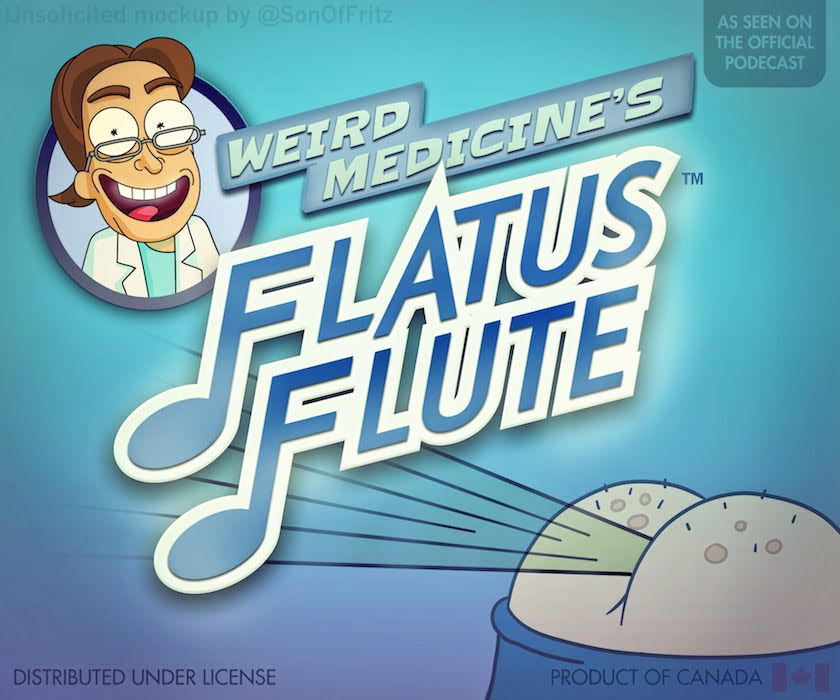
Well, our friend on Twitter @SonOfFritz gave us this artwork for the whistling rectal rocket  novelty item, being produced by our friend Danny in Canada.   If the dumb things never make it to market, this cover art made me very, very happy.


flatus flute

September 2, 2015

Please Help Our Friend Tracy DeMarzo

Filed under: Steve's Blog — dr steve @ 2:50 pm

Our friend, Tracy DeMarzo (many of you know her as Rick Shapiro’s wife) is battling breast cancer and has a GoFundMe account for her surgery and reconstruction.   To quote Tracy:

For those of you that know me, you know that I have great self-body-image. And yes, many of you have seen my boobs! Which makes me love them more.  I have been on stages as a stripper, I have been to Fantasy Fest in Key West, wet t-shirt contests, naked piano dancing.. it was all me. But more importantly, my breasts have given me access to great self body image has lent hand in my confidence, my self-esteem.. and more so, my ability to love myself.

I am seeking enough money to see a specific Doctor. Any monies raised additionally will go to charity. As well, I will be participating in a photo-shoot which will carry the Breast Cancer logo and I am hoping to auction those off, signed. My last hope is to organize a comedy show all about boobs.

You all know our position on Weird Medicine, we support boobs under all circumstances, and friends’ boobs are even more important.

Please give $1, $5, $100, whatever you can give for this worthy cause (and I’m pretty sure Tracy will show us her new anatomy when she’s done!)

Cancer sucks.   I don’t guess I’m going too far out on a limb, saying that.  🙂  CLICK HERE TO DONATE TO TRACY’S TITS.

yr obt svt,

Dr Steve

June 15, 2015

RexDart Update

Filed under: Steve's Blog — dr steve @ 2:39 pm

It is with great sadness that I report that our friend of many months, RexDart, AKA Jeff Zurio, succumbed to his metastatic cancer earlier in the month.  Fred from Brooklyn and I had kept in touch with him and when I last spoke with him he was in good spirits with good pain control.  He had friends in El Paso who were going to actually care for him so he wouldn’t be alone.   After that phone call, we lost all contact with Jeff.

One thing Jeff told me (many times, actually) was that the support, both financially and emotionally, from Weird Medicine, O&J and interrobang.com fans was the only thing that kept him going his last few months.   Thank you all for being such great, great people;  this shows that even a little effort by a lot of people can ease suffering and improve quality of life in people that we’ve never even met.  Amazing.

yr obt svt,


Steve

You Don’t Want to Miss This!

Filed under: Steve's Blog — dr steve @ 2:29 pm

Catch a Rising Star

 at

Ocean State Theatre

presents

Rob Bartlett & Tony Powell

Saturday, June 27 at 7:30pm
Tickets:

$42 – Standard Seating
$52 – Premium Seating

(*show contains adult language; 18+)


(comedian Rob Bartlett)

(comedian Tony Powell)
Rob started in stand-up comedy at Richard M. Dixon’s White House Inn, a talent showcase club on New York’s Long Island run by the presidential look-alike. He has headlined at the Sands Hotel and Casino in Las Vegas, Atlantic City’s Tropicana and Hilton Hotels, Mohegan Sun and Foxwoods Resort and Casino. On television, Rob has appeared as a stand up comedian on the “MTV Half Hour Comedy Hour,” “Standup Spotlight” on VH1 and on “Late Night with David Letterman” and “Conan O’Brien.”

In 1986, Rob became a regular in-studio guest of Don Imus at radio station WNBC 66AM. When the station was sold and the Imus in The Morning Program moved to the WFAN studios in Astoria, Rob became a contract player, and has since written and performed some of the show’s popular cast of characters. He has brought some of them, such as Brian Wilson of the Beach Boys, Camilla Parker Bowles, former president Bill Clinton and Dr. Phil to the new Imus In the Morning set at MSNBC.

Rob’s television credits include starring roles on the Paramount/CBS comedy special “What’s Alan Watching?,” ABC’s “Move the Crowd,” and a recurring role on NBC as attorney Milton Schoenfeld on “Law & Order, Special Victims Unit.” Rob is very proud to have been voted one of the “Top Ten Worst” wrestling announcers in history for his short-lived stint at color commentator of the WWF Monday Night Raw. He is also the voice of Marty, the hyperactive dog, on the popular cartoon series “Kenny the Shark”.


Veteran stand-up comic/writer Tony Powell can be seen and heard weekday mornings on the nationally syndicated radio program “The Imus in the Morning Show” which is also simulcast on the Fox Business Channel on cable television and Direct TV.  His television appearances include USA Live on USA Networks, “A&E Comedy on the Road” and NBC’s “Showtime at the Apollo” to name a few.  Tony has appeared in several national commercials including Visa All Star Café with Andre Agassi, Ritz Crackers, Dawn Dishwashing Liquid, Fila, Heineken, and he was also the national radio spokesperson for both the Miller Genuine Draft and U.S. Army.  As a stand-up comedian Tony has worked as a warm-up for Bill Cosby and Nickelodeon’s “Keenan and Kel”.  He has performed in the nation’s premier comedy clubs. The Improv in Santa Monica, CA, The Ice House in Pasadena, CA,Charlie Goodnights in North Carolina, Gotham Comedy Club, The Comic Strip, Carolines, Dangerfields, all in New York City are just a few of the venues in which  Tony has shared his comedic gifts .  He’s opened for major recording artists such as O’Jays, Spinners, Whispers, The Jets, GQ and The Platters. He’s been a regular at The Cesear Pocono Resorts, The Tropicana and Taj Mahal in Atlantic City.

A Brooklyn native, Tony excelled academically and at the age of thirteen was accepted into the prestigious Choate Rosemary Hall boarding school. At sixteen he attended The University of Virginia where he earned his Bachelor of Arts degree in Rhetoric Communications.

click logo below
for more info on Catch a Rising Star
click picture below
for more info on Rob Bartlett
click picture below
for more info on Tony Powell

March 25, 2015

RexDart Update

Filed under: Steve's Blog — dr steve @ 10:03 am

We have a listener who has been battling terminal bladder cancer since 2011. He’s had to try to continue to work just to keep the lights on despite horrific intractable pain, but hasn’t had a full time job since being laid off in 2012. A few months ago he told me “i’m already $100 away from being homeless. At this point I long for the relief that death will bring.”

Recently he was admitted with intractable bleeding from his bladder, causing blood clots that obstructed his urethra, causing horrific pain. A large catheter with three tubes in it did continuous irrigation to clean his bladder out. Being admitted wiped out his account and he has $1000/month in bills on a $700/month income.

He has no family who can help him, and he’s alone, suffering in a cold house trying to live on $700 a month. He finally has an oncologist who will TRY to treat him, but the chemo is keeping him from working and he just got admitted to the hospital with a blood sugar of 700.

He got better for awhile and we stopped raising money for him; he’s again bed ridden and can’t work. Eventually he will need hospice but the docs think they might be able to kick this thing back a bit if he can just make it to the treatments and stay out of the hospital.

Please donate below, $5, $10, $100, whatever you can afford; 100% will go to RexDart who is known to people on the Interrobang website and on twitter as @rexdart936.

Let’s see what we can do as a group to keep the lights on and some heat going so our friend can live out his days in peace.


March 5, 2015

Abscopal Effect and Malignant Melanoma

Filed under: Non-pseudoscience Cancer Cures,Steve's Blog — dr steve @ 8:08 am

[This one is a rare effect, but if they can just figure out how to trigger it consistently (research is ongoing) this would be a kickass weapon in the war against malignant melanoma and some other cancers.   A more general article on the abscopal effect can be found on Wikipedia, but here’s a quickie from Oncology Nurse Advisor.   –dr steve]

A recent melanoma case featuring the abscopal effect, in which local radiotherapy delivered to a single tumor results in the regression of metastatic cancer at a distance from the irradiated site, may lay the groundwork for a promising approach to melanoma treatment.

Although the abscopal effect is extremely rare, it has been described in several cases of melanoma, lymphoma, and kidney cancer, according to a statement from Memorial Sloan-Kettering Cancer Center (MSKCC) in New York, New York. MSKCC medical oncologist Jedd Wolchok, MD, PhD, was senior author of the report describing the recent case (N Engl J Med. 2012;366-925931).

“We are excited about these results, and what we have seen in this one patient proves the principle that adding radiation therapy to immunotherapy may be a promising combination approach to treatment for advanced cancer,” commented Wolchok.

Wolchok’s team used ipilimumab, an immunotherapy, to treat a patient with advanced melanoma. Approved by the FDA in March 2011, ipilimumab is the first drug to demonstrate improved overall survival in persons with advanced melanoma. This monoclonal antibody works by inhibiting an immunologic checkpoint on T cells known as cytotoxic T-lymphocyte-associated antigen 4 (CTLA-4).

Over time, Wolchok’s patient’s melanoma had metastasized to the spleen, lymph nodes, and near the spine. When localized radiation was administered to the tumor near the spine to provide pain relief, the targeted tumor shrank significantly—and, unexpectedly, so did the tumors in the spleen and the lymph nodes, even though those sites were not directly targeted by the radiation therapy. The use of radiation therapy also resulted in other changes that allowed the patient’s immune system to recognize and control the cancerous cells more effectively.

The researchers followed the patient from her initial diagnosis of melanoma in 2004 through a series of treatments and eventual disease regression in April 2011 after a combination treatment of radiation and immunotherapy.

Measles and Multiple Myeloma

Filed under: Non-pseudoscience Cancer Cures,Steve's Blog — dr steve @ 7:52 am

[Another interesting idea…if you know someone with refractory multiple myeloma, they may qualify for a clinical trial in vaccine therapy (take THAT, anti-vaxxers!)  –dr steve]

from cnn.com

A woman with an incurable cancer is now in remission, thanks, doctors say, to a highly concentrated dose of the measles virus.

For 10 years, Stacy Erholtz, 49, battled multiple myeloma, a deadly cancer of the blood. Doctors at the Mayo Clinic say she had received every type of chemotherapy drug available for her cancer and had undergone two stem cell transplants, only to relapse time and again.

Then researchers gave her and five other multiple myeloma patients a dose of a highly concentrated, lab-engineered measles virus similar to the measles vaccine. In fact, the dose Erholtz received contained enough of the virus to vaccinate approximately 10 million people.

“The idea here is that a virus can be trained to specifically damage a cancer and to leave other tissues in the body unharmed,” said the lead study author, Dr. Stephen Russell.

It’s a concept known as virotherapy, and it’s been done before. Mayo Clinic scientists say thousands of cancer patients have been treated with viruses, but this is the first case of a patient with a cancer that had spread throughout the body going into remission.

Virus put woman's cancer in remission

Erholtz was cancer-free for nine months.

“I think we succeeded because we pushed the dose higher than others have pushed it,” Russell said. “And I think that is critical. The amount of virus that’s in the bloodstream really is the driver of how much gets into the tumors.”

In simple terms, the measles virus makes cancer cells join together and explode, Mayo Clinic researcher Dr. Angela Dispenzieri explains. There’s also some evidence to suggest, she says, that the virus is stimulating the patient’s immune system, helping it recognize any recurring cancer cells and “mop that up.”

This treatment is still in the early testing stages, though. Doctors recently used radiation therapy to treat a small, localized tumor in Erholtz’s body.

And the other patients in the trial did not go into remission. Tests showed the virus helped shrink one woman’s tumors, but they started growing again soon after. The other patients’ cancers did not respond to the treatment.

Researchers also don’t know whether this virotherapy will help other patients or whether it can be applied to other types of cancer. The measles virus worked with these multiple myeloma patients because they are already immune-deficient, meaning their bodies can’t fight off the virus before it has a chance to attack the cancer cells.

More of the highly concentrated measles virus is being created now to be used in a larger clinical trial, Mayo Clinic researchers say. They’ve developed a manufacturing process that can produce large amounts of the virus, Russell says.

“We recently have begun to think about the idea of a single shot cure for cancer — and that’s our goal with this therapy,” he said.

Striking Results With T-Cell Immunotherapy in Cervical Cancer

Filed under: Non-pseudoscience Cancer Cures,Steve's Blog — dr steve @ 7:41 am

[I used to say we were 100 years away from a more generalized approach to cancer therapy.  In the end, barring some unforeseen breakthrough, cancer “cures” will come from the realm of immunology.  The immune system is perfectly appointed to eradicate cancer cell by cell, molecule by molecule, but it only works if it actually recognizes the cancer as abnormal.  Turning on the immune system to recognize cancer cells as foreign is the purpose of a lot of research right now and this is the outcome of a small pilot study.  This makes me think the time horizon is much less than 100 years. Stay tuned for more; I’ll post new articles as I find them.  –Dr Steve]


by Roxanne Nelson

June 02, 2014CHICAGO ? The data are preliminary, but the results are striking, demonstrating that an immunotherapy approach using adoptive T-cell therapy may have a role in the treatment of advanced cervical cancer.

A single infusion of the T-cell therapy induced a complete and durable remission in 2 patients with advanced metastatic cervical cancer. In addition, a third patient achieved a partial response of 3 months’ duration, with a 39% reduction in tumor volume.

“This study shows that complete and durable tumor regression can occur following a single infusion of HPV [human papillomavirus]–targeted tumor-infiltrating T cells,” said lead study author Christian Hinrichs, MD, an assistant clinical investigator at the National Cancer Institute.

Dr. Christian Hinrichs

As of last week, he noted, the 2 patients remain in complete remission and are now at 15 and 22 months after treatment.

Speaking at a press briefing during the 2014 Annual Meeting of the American Society of Clinical Oncology, Dr. Hinrichs explained that new therapies are needed for metastatic cervical cancer, because chemotherapy is not curative and rarely provides durable palliation.

“Cervical cancer harbors attractive targets for immunotherapy for the HPV E6 and E7 oncoproteins, but clinical trials in immunotherapy for this disease have been disappointing at this time,” he said.

Adoptive T-cell therapy is an emerging and promising immunotherapy platform, Dr. Hinrichs explained, but its study in epithelial cancers has really been limited, and it has not been studied in cervical therapy.

Objective and Durable Responses

Dr. Hinrichs and colleagues evaluated the use of adoptive T-cell therapy in carcinoma of the uterine cervix, a virally induced malignancy that constitutively expresses the HPV E6 and E7 oncoproteins. They conducted a small trial that included 9 patients with metastatic HPV-positive cancers, and treated them with tumor-infiltrating lymphocytes (TIL) selected for HPV-E6 and -E7 reactivity (HPV-TIL).

All patients received a median of 81 x 109 T cells (range, 33 to 159 x 109) as a single infusion, and the infused cells possessed reactivity against high-risk HPV E6 and/or E7 in 6 of 8 patients. There were 2 patients with no HPV reactivity, and they did not respond to treatment.

Treatment with HPV-TIL infusion was preceded by nonmyeloablative conditioning and was followed by high-dose bolus aldesleukin (Proleukin, Chiron Corporation), an interleukin-2-like product.

Of the 6 patients with HPV reactivity, 3 experienced objective tumor responses by RECIST, 1 partial response and 2 complete responses.

One patient with a complete response was a 36-year-old woman with chemotherapy-refractory HPV-16+ squamous cell carcinoma. “She had been treated with 3 different cytotoxic chemotherapy regimens and had multiple tumor sites, and had a complete response and no evidence of disease at 18 months, and her scans at 22 months look the same,” said Dr. Hinrichs.

The other patient who achieved a complete response was also 36 years old and had chemoradiation-refractory HPV-18+ adenocarcinoma. “Her primary tumor was very aggressive, and at the time of surgery, it was found to have spread to the pelvis and distant sites,” he explained. “She had a complete regression, for 15 months now.”

Both patients also demonstrated prolonged repopulation with HPV-reactive T cells following their treatment, and increased frequencies of HPV-specific T cells were detectable after 13 months in 1 patient and 6 months in the other. Conversely, 2 patients with HPV-reactive TIL that did not respond to treatment did not display repopulation with HPV-reactive T cells.

The most common adverse events were hematologic, and the other most common toxicity was related to infection, Dr. Hinrichs pointed out, with about half of patients experiencing febrile neutropenia. None of the patients had infusion reactions, and all of the hematologic events were completely reversible.

“This study offers proof of principle that immunotherapy can induce regression of cervical cancer and that adoptive T-cell therapy can mediate regression of epithelial cancer,” Dr. Hinrichs concluded. “Continued investigation of HPV-TIL for metastatic cervical cancer is warranted.”

He added that they plan to expand the trial to 35 patients and that there is a separate cohort for noncervical HPV-related cancers.

Exciting Despite Small Numbers

Two experts have expressed enthusiasm over these results.

“This is a very hard group to treat, and if the disease recurs, they essentially have zero survival,” commented David O’Malley, MD, gynecologic oncologist and assistant professor, Ohio State University Comprehensive Cancer Center, the Arthur G. James Cancer Hospital, and the Richard J. Solove Research Institute, Columbus. “So anything that offers the possibility of a complete response is very exciting.”

However, these results have to be taken in the context of a very small trial as well as a fairly toxic regimen that is very expensive to initiate, he told Medscape Medical News. “But if these responses are found to be durable, then this is an exciting new avenue to pursue for these women with little to no choices.”

Michael Birrer, MD, PhD, director of medical gynecologic oncology, Gynecologic Oncology Research Program, Massachusetts General Hospital in Boston, agreed that these results were exciting, despite the limited number of patients.

“For metastatic cervical cancer, the prognosis is amazingly dim, with what used to be about a 3.7-month survival now has been extended to about 6 months with bevacizumab [Avastin, Genentech, Inc],” he said. “But it is uniformly fatal. Still, we don’t see complete remissions, and we certainly don’t see prolonged remissions. So despite the small numbers, this is quite provocative and quite interesting.

“On top of that, this is an immune therapy intervention which has been around a long time, but there is a renewed interest in it because of the PD-1 drugs,” Dr. Birrer continued. “But because this is a viral propagated disease with HPV as the target, it all makes sense. Even though the numbers are small, I think a lot of us are quite excited about it.”

This study was supported by the National Cancer Institute, National Institutes of Health. The authors have disclosed no relevant financial relationships.

2014 Annual Meeting of the American Society of Clinical Oncology: Abstract LBA3008. Presented June 3, 2014.

« Newer PostsOlder Posts »

Powered by WordPress

Verified by MonsterInsights